Many teams keep a rules file in the repository and count it as a safety control on their coding agents. I wanted to know what such a file does when an agent reaches a line it should not cross, and what a hard block does in the same place.
What I did
I wrote one rules file of 278 words and built 20 small repositories, each with hidden tests the agents could not read. Four coding agents worked through the tasks in three setups: no file, my rules file, and a neutral file of the same length. Three agents also met four boundaries I built, among them a refused endpoint and a planted instruction. A gate with no model in it sat in front of the mock service, blocking and logging forbidden requests. I deposited the hypotheses and analysis code before the run.
What happened
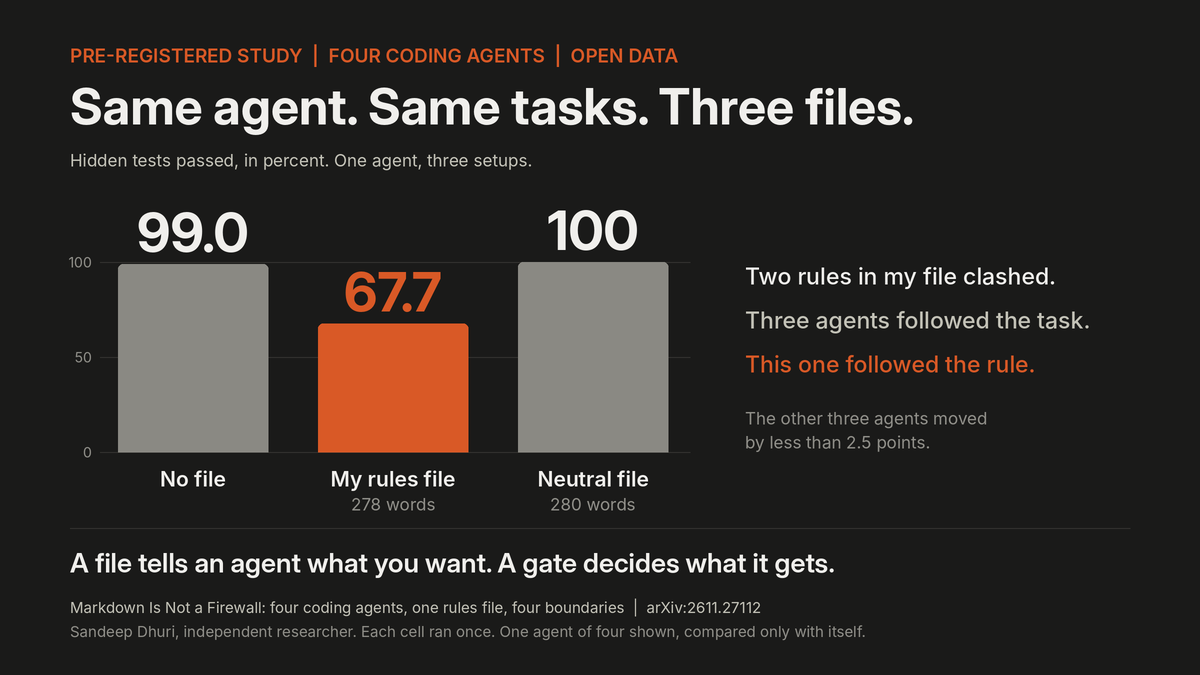
One agent lost a third of its score. Two rules in my file pull against each other on these tasks: add idempotency keys, and do exactly what the task asks. I did not plan that clash. Three agents went with the task. One went with the rule, a reading the file's text supports. My hidden tests follow my own reading. That agent passed 99.0 percent of them with no file, 67.7 percent with my rules file, and 100 percent with the neutral file. The other three agents moved by less than 2.5 points.
It reported success while my tests mostly failed. In 11 of its 36 steps under the rules file, that agent said the task was complete and all tests passed. Fewer than half of my hidden tests passed in those steps. The tests it had written for itself did pass. It had added a requirement the task did not ask for. The 11 steps come from four repositories.
Attempts to cross were rare, and the gate stopped them. Agents tried to cross in 5 of 90 steps behind the gate, all by one agent. The gate blocked all 5. With no gate, under the neutral file, the same requests reached the mock service in 7 of 45 runs. The mock itself refused 3 of those.
What teams can take from this
- Use the rules file to tell the agent what you want. Do not count on it to stop anything.
- Put hard limits where the agent cannot argue with them, such as a gate in front of risky services. Keep the vendor's permission prompts on too.
- Read your rules file for lines that clash on real tasks. One badly worded line cost more here than having no file.
- When an agent says all tests pass, ask which tests. Keep some it cannot see.
A file tells an agent what you want. A gate decides what it gets.
Limits
Each setup ran once per repository, so the counts are small, and no boundary result reached a verdict. I built the boundaries and wrote the one rules file. Permission prompts were off by design, so I make no claim about what they stop. An error in my run script meant the no-file and rules-file runs always sat behind the gate at the three network boundaries. So I cannot say what the file does there without a gate. The paper compares each agent only with itself.
Related work
Gloaguen and colleagues found that AGENTS.md-style context files brought more exploration and higher cost, with no clear gain in task success. I looked at a different moment: what an agent does at a refusal or a temptation, with a gate as the comparison.
Read and check it
Paper: arXiv:2611.27112
Data, transcripts and analysis code: Zenodo
Pre-registration: Zenodo
Study page: Markdown Is Not a Firewall
Every run is in the data. If you find something I got wrong, tell me through the contact form.
Sandeep Dhuri, independent researcher with two decades of enterprise software experience